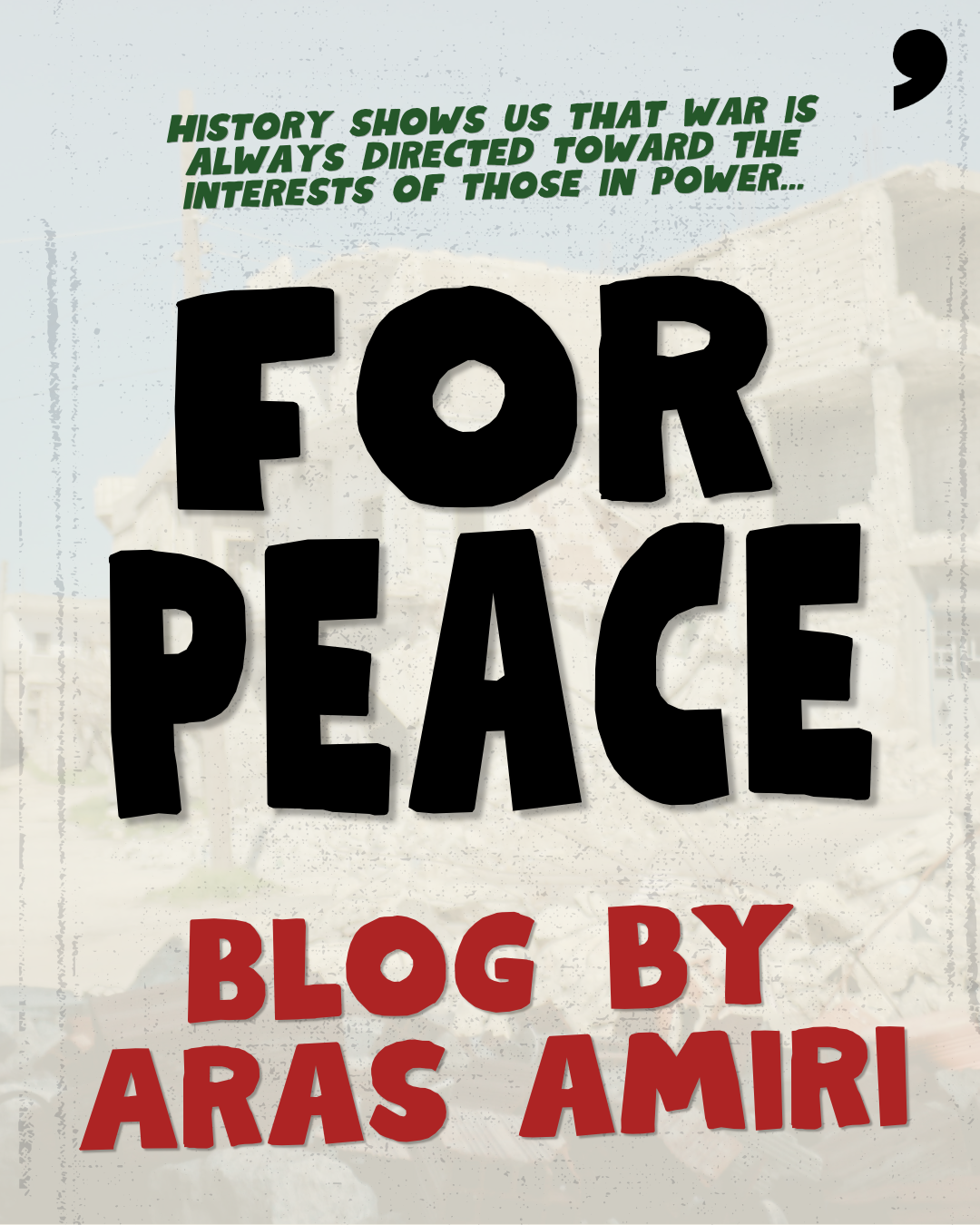
For Peace: Blog by Aras Amiri
History shows us that war is always directed toward the interests of those in power…
A letter written for Walk Peace event in Jersey on 17 April 2026
9-17 April 2026
I am writing this, imagining us gathering for peace and the meaning of our action. Today is the second day of a precarious ceasefire between Iran, the United States and Israel. I can breathe again, which makes me recognise the anxiety, the pressure, the fear, and the pain of the last 42 days since the war began. All the feelings one pushes down in order to face the horror of destruction and the suffering that is happening, and has already happened, already lost. To face the reality of not knowing which of your family and friends will still be alive tomorrow, and what will survive of houses, of cities, of over 7,000 years of civilisation. And how strange is the displacement of witnessing this from outside Iran while it is burning.
There is no suffering like war, no terror like war, no lack of freedom like war. In war life itself perishes; the body itself invaded.
When the previous invasion by Israel and the United States against Iran happened in June 2025, I felt guilty for not knowing enough about the pain of the people in Palestine, Sudan, Ukraine, and elsewhere. For not knowing enough about the pain of those who lived through the many wars that have happened since my birth, in 1986, during the Iran-Iraq war (1980-1988) - the war that killed my grandfather. What a misplaced response guilt can be. There are certain meanings that cannot be grasped without experience, yet they are approachable through active empathy, solidarity, and consciousness. And perhaps this recognition is a fragment of peace. So, I breathe in this possibility of peace, which opens these words — the very faith in articulation of “peace” is an act that calls upon its presence.
What does peace entail in our political moment? What is our imagination of peace and how does it connect to hope, justice and freedom?
The question of peace is necessarily both social and political. I say this not to undermine “the personal peace” and the metaphysics of life, but to recognise that “peace” is a social reality and, as such, depends upon social and political conditions for its emergence.
A peace resulting from war cannot give rise to freedom. This imposed peace means that diverse political forces are silenced, instead of being allowed to co-exist, which is the essence of social life. It means the killing of civilians; exploitation, destruction of civil infrastructure and life; suffering, and perpetuation of violence. The peace known to the government of Israel and US is of this kind, which is a shameful abuse of the word.
We need to understand our situation in the context of history, to look at both material and immaterial ruins, to situate ourselves and to reflect on what we have achieved and learnt over time as we pursue our struggle for peace and freedom.
It is our connections with each other, with our own bodies, and with the land that enable peace. We have achieved a disclosure of truth that can no longer be denied through the abuse of the history of Jewish suffering; the presence of millions in the streets across the world testifies to this. After long years, Europe and the US have become politicised again. People are reclaiming the meaning of politics as something that should bring peace, security, equality, and prosperity — regardless of class, gender, sexuality, belief, and race — as something that should serve them and their desire to live with one another in mutual freedom. So now, changing governments and inequitable social realities are no longer confined to the imagination of minorities, but a real political possibility.
We have learnt that all components of social equality are connected, so should be our struggles for realising them. The struggle for freedom of sexuality is not separated from women’s liberation; the fight for freedom of Palestine is not separated from the resistance against domination of finance capital in Jersey. We have learnt that we are connected and need to organise our connections locally and internationally. We have learnt collectively as people of the world and yet what different people have paid and gone through for such political awareness is profoundly unequal. This makes it more urgent to concentrate our actions — not to serve our feelings or our own political desires, but in ways that respond to what is needed collectively. I have learned recently that the most difficult act is to separate my own political desires from what those desires mean for someone living under bombs, and to prioritise the latter.
There is a tendency to view Iran and their retaliation against Israel and the US as the last remaining possibility of resistance against the genocide in Palestine. There are many who share this view, both among Iranians and people of other countries. In this view, war is accepted as inevitable, due to the fascism of Zionism and its allies; and then justified because of this inevitability and the need for resistance. The war is not supported but accepted and then idealised as that which can bring end to catastrophe, as the war for peace. I understand, and at times find myself inclined towards this position. My desire for change and resistance, and my human instinct of no longer being able to bear witness to the killings of innocent people and children, decapitation, hunger, rape, imprisonment, and the obliteration of entire worlds, demand an immediate end to this catastrophe caused by Israel, supported by the United States, and enabled by the complicity of many governments. The word catastrophe cannot sufficiently express what this is, the reality of suffering in Palestine and now southern Lebanon and Iran is unspeakable and it will remain unspeakable in history, in the same way that Auschwitz has. Israel’s ongoing occupation and genocide entail not only the end of human lives and the world that the name Palestine holds, but a severe defeat of humanity, one that not only affects us now, but also deprives us of peace in the future.
Nevertheless, I want to argue that such a political position, which closes its eyes to the roots of what Edward Said termed the “Question of Palestine” and to the crimes of the Iranian government against its own people, is a false hope — one that obstructs the real hope for peace. I want to speak of a kind of peace that avoids war, one that is interwoven with hope and freedom, and pursued through long-term action, organisation, the building of alliances, and endurance.
I want to dwell on the problems of this position, not because I have lost sight of the fact that the main cause of war is the occupation and invasion by Israel and the US, but because I believe that the political agency aligned with this view can bring about transformation if it navigates the situation differently.
As long as the aggression and invasion are ongoing, there is no possibility of peace without resistance and what is more precisely called “self-defence”. But the question for all of us, outside the sites of conflict is, how do we support this resistance with an outlook of peace?
Our responses should be within our political remits and possibilities and carried out by our collective work. More importantly for the sake of peace, if Iran carries out the resistance against Israel, the conditions which have created the state of Israel and the rise of fascism, will not end. If the roots and conditions of this historical problem are not the target of change, they will perpetuate, as they always have, regardless of the different ideologies that present themselves at the surface. Fascism should be understood in relation to domination of finance capital, and racism should be understood as exploitation.
History shows us that war is always directed toward the interests of those in power—especially within ideologies that rely on war and destruction for their survival. It shows us that crises are not only a means of distraction, but a core function of capitalism. Such crises compress time into no time. They make endurance and long-term struggle seem impossible; they silence hope, as hope manifests as the ability to see other possibilities. Hope expands time; it enables the imagination and the recalling of peace — as that which cannot be killed, as that which we pass on to future generations as our connection to peace.
Thank you for listening.