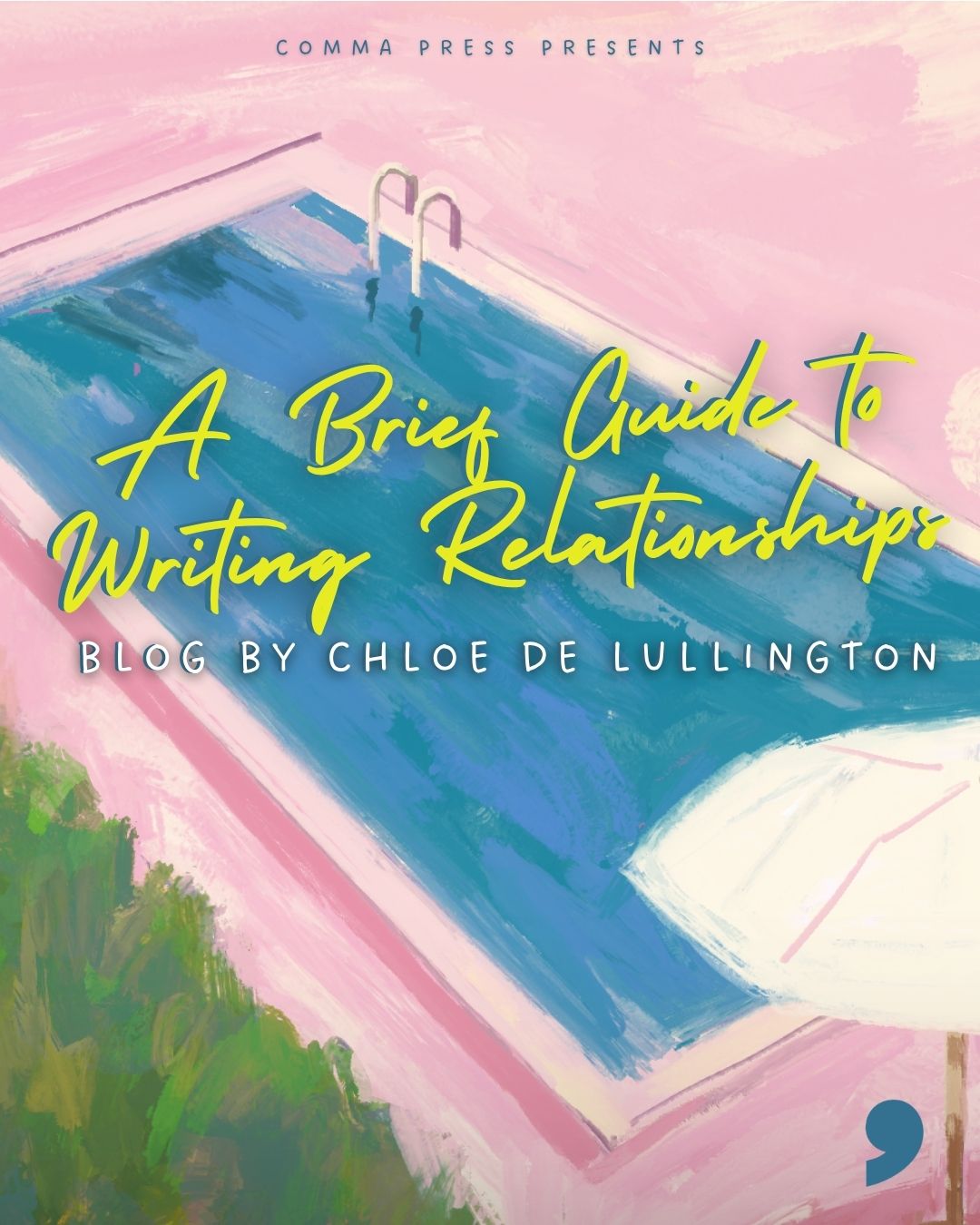
A Brief Guide to Writing Relationships
Author Chloe De Lullington gives some pointers on relationship writing ahead of her upcoming short story course.
At the core of the human existence is one key drive: the desire to be loved.
Relationships and romances are fascinating to us, and we love hearing about them, exploring their recesses, dissecting them with other people. This fascination is borne out commercially too: romantic fiction is the highest-grossing genre, outselling mystery, science fiction, and fantasy combined. The global romance books market was valued at $18.89 billion in 2024, and by 2033 is projected to rise to an astonishing $28.06 billion.
The universality of the genre is undeniable, and the scope for representation is boundless. From the propriety of Jane Austen to the bodice rippers popularised in the 1970s, romance fiction has been on quite the cultural journey, and is now arguably experiencing its biggest ever boom in terms of both variety and popularity. Whether you’re seeking diversity, selecting your romance reading materials by the ethnicity, gender, or sexuality of the main characters, or a specific setting (sports romances are booming; we’ve all seen the Heated Rivalry love!) you’re bound to find a writer creating just the kind of thing you’re looking for. And if you can’t find one – become one yourself! (Read on for more on how you can get started with this…)
But what makes a story a piece of romance fiction?
For many, the Happily Ever After (HEA) is a key marker of the genre, identifying the form through its ending. Commercially, however, the HEA can present a somewhat tricky prospect, especially if you’re writing a series. If your couple ride of happily into the sunset at the end of the tale, where do we pick up in the sequel? Do we break them up, have their relationship encounter real-world pressures like childbirth, illness, adultery – or do we let them take a back seat and focus instead on a supporting character from the first story, allowing them their own romantic journey? For some writers, the solution lies in a Happy For Now (HFN) which establishes the contentment of the relationship in its current iteration while leaving room for wider plot arcs and character development in subsequent instalments of the story.
And of course, not every story about relationships can be classed as “a romance”, even if it features romantic elements or moments. There are many novels which focus on interpersonal, romantic, or sexual relationships as their primary topic but wouldn’t be considered – or marketed as – “a romance”. Indeed, for Jessica Strawser, a writer, editor, and USA Today bestselling author of book club fiction, the HEA forms a key distinction between “a romance” and “romantic fiction”. The former always has its HEA, whereas the latter can be open to other endings, such as a HFN or even something less positive, right up to a tragic ending.
For Pamela Regis, whose academic specialisms include popular romance fiction and the courtship novel, there are eight key features that appear in a romantic novel. She lays these out in her 2003 work A Natural History of the Romance Novel.
Regis’ eight narrative elements of romantic fiction are:
- Depiction of the initial state of society in which the romantic leads must court
- The couple's meeting
- The barrier/s between them
- Their attraction to each other
- Their declarations of love for one another (which can happen at separate times)
- The point of ritual death (at this point, it appears the romance can never go forward)
- Recognition of the means to overcome the barrier/s
- Betrothal (or modern-day equivalent of commitment)
Due to the requisite brevity of short fiction, not all of these can necessarily be included in a short romantic story, but they provide a compelling framework for understanding the parameters of the genre. They’re also great as the basis for individual writing exercises; by focusing on one feature at a time, writers can develop a comprehensive understanding and expression of their world, characters, key themes, and narrative arc.
In addition to her eight core elements, Regis also identifies three further frequently occurring, but non-essential, features of romantic fiction. These are:
- Scapegoat (sometimes a barrier character) exiled
- Bad character (sometimes a barrier character) converted to good
- Wedding, dance, or fete
Armed with these elements, it’s easy to see how we can begin plotting a romantic story of our own – and that’s before we even get into the juicy world of tropes, which is where we can niche down into things like grumpy x sunshine, fake dating, second chance romance, enemies to lovers, and more!
Interested in learning more about the craft of short fiction with a focus on romance and relationships – and writing your own romantic fiction to be published in an eBook anthology? Join Comma Press’ upcoming online three-month writing course, led by Chloe de Lullington and hosted on Zoom. Bursary places are available.
And if you’re looking for your next short fiction romantic read, these collections are a great place to start:
- The Anthology of Love and Romance, ed. Kate Alexander, 1994, Tiger
- Who’s Loving You? Love Stories by Women of Colour, ed. Sareeta Domingo, 2021, Trapeze
- These Kindred Hearts: 17 Tales of Love and Magic, ed. Shari B. Pennant, 2026, Sweet July Books