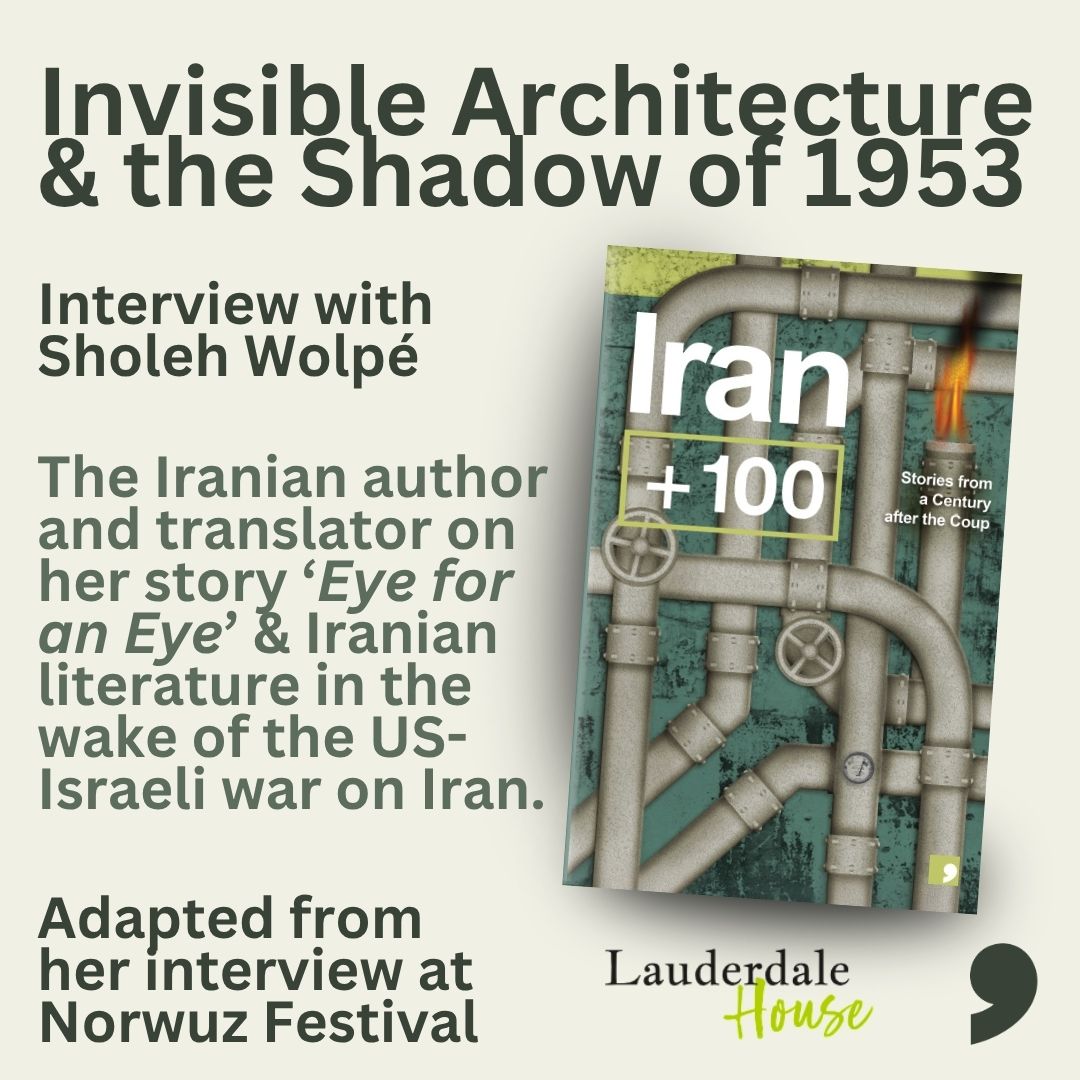
Invisible Architecture and the Shadow of 1953: Interview with Sholeh Wolpé
The following interview with Iranian author and translator Sholeh Wolpé has been adapted from her pre-recorded appearance at the launch of Iran + 100 at Nowruz Festival, taking place this Tuesday March 24th, 2026 at Lauderdale House, London. Tickets still available
Where did the idea for ‘Eye for an Eye’ come from?
It really came from something very personal and very ancient in me. I grew up in a world where power, whether it's religious, political, social, was almost entirely in male hands. And you learn very early as a girl what is allowed, what is not, how your body is read, how your voice is managed, even in the most ordinary moments. There is sort of like an invisible architecture that shapes your life as a girl. And I remember when I was very young, wondering quietly thoughts you're not supposed to think: what would happen if women were in charge? And it's a question that I think I still ask myself. Would things be gentler, fairer? Or would power itself, regardless of who holds it, begin to harden the same way? So that question stayed with me for years, and my story, Eye for an Eye really grew out of that tension, not as a fantasy of reversal, but as an exploration. If women take over, do they undo the system, or do they inherit it? Do they dismantle violence or learn to wield it? So the story comes from that long-lived curiosity in my head, and maybe also a refusal to accept easy answers.
‘Eye for an Eye’ frames the struggle for progress as an inter-generational family conflict, more complex than one side being right and the other wrong. Is that fair?
That's exactly right. I didn't want it to feel like one side is right and the other is wrong because that's rarely how things work in real life, as we see today as exactly what's happening in Iran, right? So what interested me was that both sides believe they are justified because isn't that true in most situations? We call it self-righteousness which comes to human beings quite naturally, unfortunately. And in my story the father character thinks he's protecting order, faith, morality and yes, his own daughters, and then the daughter thinks she's fighting for justice and freedom. But both of them, in different ways are capable of violence, and both are certain that they are right in what they expect from the world and what they believe justice is. And by the end, not to give the ending away, but even though the daughter's side, I mean, we know it may win, we start to see old patterns repeating. And that's really the core of the story for me, not equivalents, but how easily cycles of power reproduce themselves. And it's the child, the narrator, who senses that something is off. That maybe justice, when it becomes punishment, starts to look like what it replaced.
The story feels inspired by the Woman Life Freedom protests. Would the story be different if you had written it now in the wake of recent hostilities?
The story definitely came out of the emotional intensity of the women life freedom movement. And there was a kind of clarity then, a sense of urgency and hope, I think. But if I were writing it now, I think I'd still keep the family at the centre, but I'd widen the lens a bit because now we're also dealing with regional conflict with outside forces, with the way movements can get entangled in geopolitics. So I think I'd be more conscious of how a struggle for freedom inside a country can be complicated or even distorted by what's happening outside of the country. Still, this is a short story - a story that hopefully leaves the reader thinking more closely about the concept of justice. But if I were writing a novel, the story might expand beyond the closed system and explore how vulnerable we are to the pressures of the world.
You talk about ‘abroo’ & maintaining family honour. Is there a similar pressure among the diaspora who have fought for progress to keep the message consistent, even in the wake of the war?
It’s a very complicated situation right now. I don't think I can comment as an expert because I'm not an expert. I'm not a sociologist; I'm not a political analyst. But since you mentioned abroo, traditionally, abroo is about family honour, and about how you're seen. I think something similar exists in progressive spaces - this pressure to be consistent to not break ranks, to not say something that might be used against your cause. Can we call that abroo? I don't know. At least not in the sense that I have been exposed to as a girl and a woman in my family and society, which is how I make use of it in my story. But whatever it is, it creates a real tension between being ethically honest and being politically aligned, and I think, a lot of people feel that, even if they don't always say it out loud. But going back to the word abroo, if I had absolute power over our language, I would completely eliminate that word! And hopefully by its erasure over time. What that word carries, its expectations, its gown of shame would slowly disappear as well.
Iran + 100 is about the legacy of the 1953 CIA/MI6-backed coup against Mossadegh. Has that history been lost in the shadow of the 1979 revolution?
I don't think 1953 has disappeared, but I do think it's been overshadowed. So for many people, especially the younger generation, 1979 and everything that followed feels much more immediate, much more personal. So 1953 to them can start to feel like sort of a distant memory, and unless you're educated, you don't even know what truly happened or why. But it's still very much there underneath everything. It shaped a deep mistrust, and rightly so, of foreign intervention, of imposed political change which is now happening again. So even when people don't talk about it directly or even are not consciously aware of it, it's still part of the emotional and if there is such a thing, a political DNA of, of Iran, and I think part of what we have to do, through storytelling, through literature, is to reconnect to those threats to show that those moments aren't isolated. They're part of the same story that’s still going on today. And I think the stories (of Iran + 100) do that. Anyway that’s not unique to Iran, the world is a connected web, as Sufi mysticism says, and we're not isolated. What happens to a nation or its people or culture reverberates through the world. That's why I'm not only a writer, but I also translate Iranian literature. I believe literature helps us see this connection. It helps us step back and see ourselves as a part of the web, which then makes us more human.
In this desperate, shifting situation, how do you find hope?
It’s insane in Iran but as I said earlier, is something that has been going on all over the world: to Rohingyas, Palestinians. This absolute insanity that has taken over the world started long ago, and it's very natural that whatever tragedy that happens, when it happens in your own family, you feel it more intensely, right? And when it's your country it’s kind of your extended family and everyone there who loses his or her life is a family tragedy for us, but I am a follower of Sufi mysticism. I'm a follower of Attar, and I've translated his work with a lot of love and I try not to limit myself to mourning only my family tragedies. I mourn more wildly and I've been mourning for a very, very long time. I take refuge in literature because as a writer that's all I can do. We all have to see within our own lives and our own capacities what we are capable of doing. You know, I, obviously, I'm not in Iran to go out protesting or giving my life, I'm out here, but who am I? I'm a bi-cultural, bilingual poet and writer. What is within my capacity? My capacity is to translate our heritage, to show the world who we really are. That's my role. As far as predicting, I cannot even predict what's going to happen. Just like in my story Eye for an Eye, in the end you find that there is no right or wrong. What remains is our humanity and how we manifest that humanity in the world.
Tickets for the Iran + 100 launch at Lauderdale House are available here.
Sholeh Wolpé is an Iranian-American writer, whose literary work includes seven collections of poetry, several plays, five books of translations and three collections, as well as texts and librettos for the choir and opera. Her most recent works include The Invisible Sun – Attar (Harper Collins, 2025), Abaco de Perdida (Visor Libros, 2025), and Abacus of Loss: A Memoir in Verse (University of Arkansas Press, 2022). She is the Writer-in-Residence at the University of California, Irvine (UCI), and the poetry editor at The Markaz Review. She presently divides her time between California and Barcelona.
Buy Iran + 100 HERE