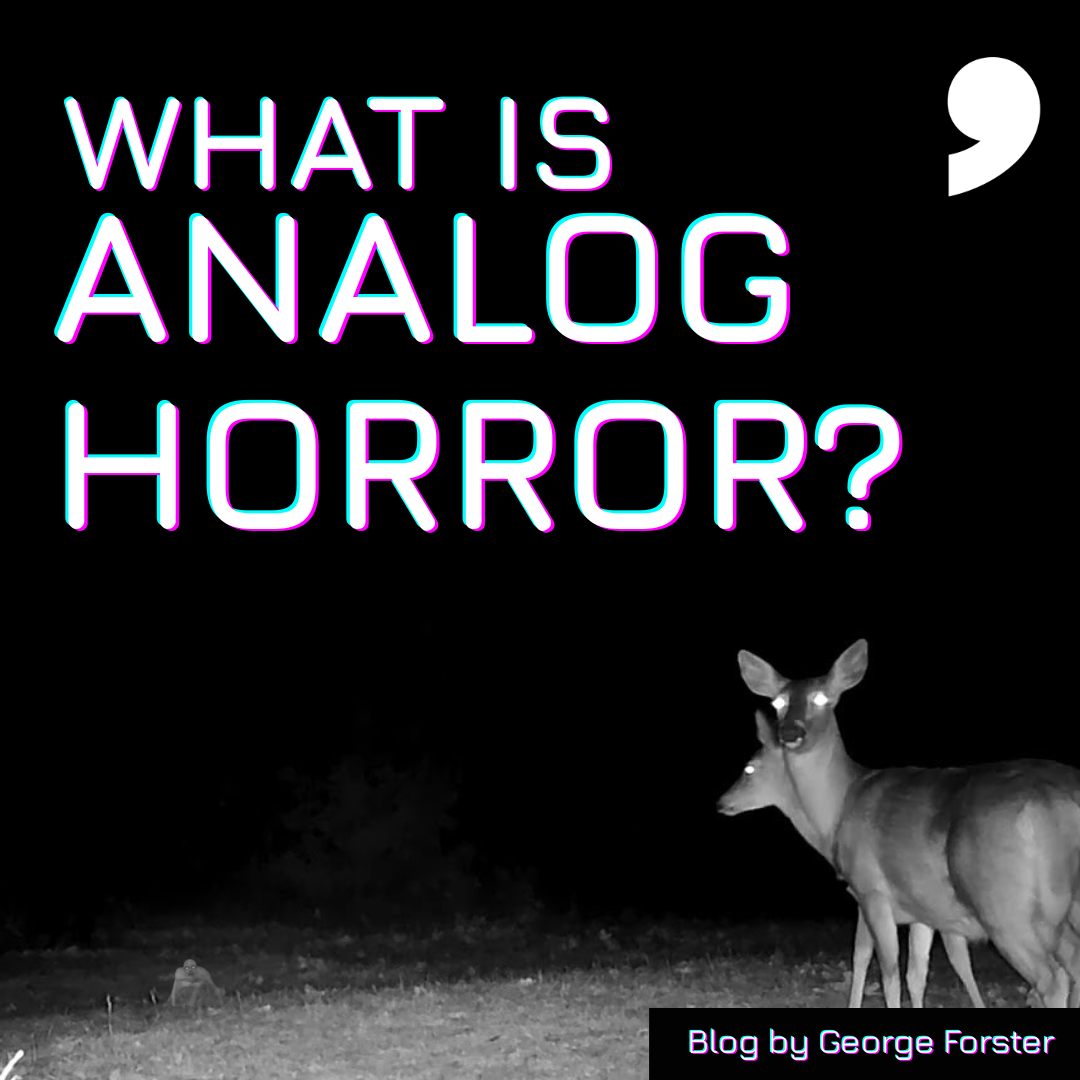
What is Analog Horror? Blog by George Forster
Whilst firmly a 21st century subgenre nostalgic for the late 90s and early 2000s, beneath the surface Analog Horror is deeply rooted in earlier traditions, particularly those of found-footage and found-text films and literature.
Analog Horror is an emerging subgenre characterised by a late 90s/early 2000s media aesthetic and the use of the implied and the uncanny over more conventional horror tropes such as jump scares and gore. Analog Horror draws its power from imitation—specifically the imitation of outdated media formats such as VHS tapes, public access broadcasts, and educational films. Its aesthetic is deliberately degraded, with distorted audio, visual tracking errors, ominous pauses, and uncanny interruptions, creating a sense of authenticity and unease, as though the viewer has stumbled upon something never meant to be seen.
Whilst firmly a 21st century subgenre nostalgic for the late 90s and early 2000s, beneath the surface Analog Horror is deeply rooted in earlier traditions, particularly those of found-footage and found-text films and literature.
Like its parent genres, Analog Horror stories create a deeper sense of dread than conventional horror by blurring the line between fiction and reality. Found footage films present themselves as recovered recordings, often left behind after a mysterious or catastrophic event – think The Blair Witch Project, Paranormal Activity, Cloverfield. The camera is no longer a neutral observer but a participant, often held by characters who are themselves vulnerable or unaware of the full scope of the horror. Analog Horror adopts this same conceit but shifts the medium. Instead of handheld cameras, it commonly uses institutional recordings—training videos, emergency broadcasts, or archived tapes. This creates an impersonal, systemic kind of dread.
Here, Analog Horror has roots to older literary traditions – those of cosmic horror, epitomised by the likes of H.P. Lovecraft. Like cosmic horror, Analog Horror texts often imply the protagonist (and often the viewer) is an insignificant part of something larger and ultimately unknowable. Analog Horror’s use of institutional texts suggests there is an in-group who are privy to vital information to which you are not, and the worlds it creates follow rules we do not know.
Analog Horror has deeper roots in found text narratives. These stories are presented as discovered documents—letters, diary entries, transcripts—compiled after the fact and presented to the reader. Classics of this genre include Sir Arthur Conan Doyle’s ‘The Horror of the Heights’ which are the writings of an aviator who went missing whilst attempting to fly higher than had ever been done, recovered in a field below his flight path. Other key examples are Bram Stoker’s ‘Dracula’, which is comprised of letters, diaries, news clippings and phonograph recordings.
Classic examples rely on fragmentation, often through physical deterioration of the text, and unreliable narration, forcing readers to piece together the truth from incomplete evidence. Analog Horror mirrors this through scattered clues and corrupted media. Viewers interpret cryptic messages, hidden frames, and distorted speech, reconstructing a narrative that is never fully explained. The horror emerges not just from what is shown, but from what is implied and left unresolved.
What distinguishes Analog Horror is how it merges these influences with modern digital culture. While it mimics analogue media, it is distributed through platforms that encourage community analysis and speculation. Audiences become active participants, decoding symbols and sharing theories. This collaborative engagement echoes the interpretive effort required by found text stories, but on a collective scale.
Ultimately, Analog Horror thrives on the uncanny tension inherent in distortions of the familiar. By borrowing the authenticity and fragmented storytelling of found footage and found text horror, it creates an experience that feels both real and unknowable, as if something has slipped through the cracks of reality.
If you want to learn more about Analog Horror, and to try your hand at writing your own with expert guidance from author Brontë Schiltz, sign up to our upcoming online short story course here.