Somewhere Between Mythology and Martyrdom
Iranian translator and Persian history graduate Jim Preacher (pen name) reflects on the fears and frustrations of the first week of America and Israel's war on Iran
Today is Friday, 6 March 2026. Six days have passed since the US-Israeli war on Iran began, and today is the first day I have allowed myself to ignore the constant pinging of news alerts on my phone. I'm not sure if I feel better or worse for it. I have spent the past week glued to my phone, desperate for news updates or to hear from friends and family in Iran who have struggled to access the internet since the government’s communications shutdown. All the while, I’ve watched in abhorrence as cultural heritage sites that I visited just two months ago have been destroyed (inadvertently or not) by the joint US-Israeli effort to seemingly flatten the country.[1] One such site was the Golestan Palace, Tehran’s only UNESCO World Heritage Site, which suffered extensive damage to the intricate ayeneh-kari (‘mirror-work’), stained glass windows, and other priceless artefacts that adorn its halls.[2] This should, by any reasonable expectation, disgust every Iranian monarchist that we’ve seen cheering on the bombs: the palace’s Marble Throne terrace and Grand Reception Hall hosted the coronations of Reza Shah and Mohammad Reza Pahlavi in 1926 and 1967, respectively. Trump himself said in a series of tweets following the US assassination of Qasem Soleimani in 2020 that such cultural sites could be the targets of future military attacks—a war crime under international law—so this campaign of cultural decimation shouldn’t come as a surprise to anyone who has been paying attention.[3]
The significance of this assault on Iran’s cultural history pales in comparison to the strikes on hospitals, schools, sports clubs, airports, and residential buildings that have, in less than one week, killed more than 1,000 Iranians civilians.[4] Unfortunately, there are already too many harrowing reports of such strikes to recount here with the attention and detail they deserve. The US attack on the Iranian girls’ school in Minab that killed 168 people, the vast majority of them children, occurred within mere hours of the first strike on Iran but remains perhaps the most horrifying atrocity committed against Iran’s civilian population so far.[5]
Whilst the people inside Iran endure aerial bombing campaigns and a potential food shortage[6], many Iranians abroad face a different kind of psychological warfare—from both the dehumanisation of Iranians in mainstream Western media[7] to the mass hysteria that has spread through much of the Iranian diaspora we see celebrating the indiscriminate bombing of their country’s ancient towns and cities. I have several friends across England who have already been ostracised from their local Iranian communities and now fear for their personal safety having merely expressed disapproval of the bombings and concern for their families.
While many Iranians abroad haven’t heard from their families since the war began, I have been lucky enough to make contact with several friends inside Iran whenever their VPN apps have allowed them to bypass the nationwide internet blockade. The feeling of relief upon receiving their messages, however, is quickly replaced by the dread of not knowing if or when I’ll hear from them again. The reality is that the country has had no shortage of conflict and mass-casualty events in recent years; many of my friends are treating this war like just another crisis that probably won’t impact them and shouldn’t stop them from staying in Tehran and living their lives.
Messages from some of my friends have been disheartening in other ways. Much like pre-revolutionary Iran in the late 1970s when Iranians would assign blame for every national tragedy to the Shah and his secret police SAVAK,[8] many Iranians now reflexively blame the Iranian government for deliberately striking civilian infrastructure in the country to garner sympathy from the international community. And there are reflections of these pre-revolutionary conspiracies everywhere you look. You will often hear Iranian monarchists insist that none of the key figures involved in the revolution and establishment of the Islamic Republic were actually Iranian—one of many claims that the Shah himself made about Khomeini in his notorious newspaper article ‘Iran and the Red and Black Colonialism’; credited by some historians as the trigger for riots that eventually snowballed into the Islamic Revolution of 1979.[9]
Contrary to the revisionist claims of exiled Iranian monarchists, Iran’s Islamic Revolution in 1979 was a popular one; the culmination of a year of nationwide strikes and protests by a coalition of forces all united by their hatred of the Shah. In his final year, the Shah had tried to make concessions to his opponents: closing casinos and nightclubs; restoring the Islamic Calendar; promising greater parliamentary power; appointing popularist Prime Ministers. But after decades of political censorship and harsh crackdowns on dissidents, these sudden concessions were seen as a sign that the Shah was faltering. Perhaps Iranians didn’t think too hard about it at the time, but in their revolutionary fervour most saw a return to traditional, Islamic values as the natural cure for the secular, westernised society that the Shah had been trying to build. In the March 1979 referendum, roughly 98% of the 20 million people who participated voted in favour of establishing an Islamic Republic in Iran.[10]And while these figures may appear inflated, I think the images of the many thousands of unveiled female students cheering for Khomeini on the streets represent a similar kind of revolutionary hysteria that we see amongst the Iranian diaspora today—a wilful ignorance of the long-term consequences for the sake of short-term gratification. The problem now with this Iranian penchant for mythology is that it undermines the many legitimate criticisms that they have of their government and justifies the Trump administration’s current ‘bombs-for-peace’ absurdity.
As the conflict enters its second week, I am also reminded more and more of the Iran-Iraq War (1980–1988) and the asymmetrical warfare that defined it. The war was preceded by years of simmering tensions between the two countries: in 1969, Iran violated their 1937 treaty with Iraq by navigating the Shatt al-Arab without flying the Iraqi flag or paying a toll; years of Iranian military support for Kurdish separatists culminated in direct military confrontation in late 1973, which led to the signing of a new accord much less favourable to Iraq. Despite the social and political turmoil of the 1979 Islamic Revolution, Iran’s new leaders attempted to export their ideological revolution to Iraq through religious rhetoric and multiple assassination attempts on Iraqi politicians. Iraq’s new strongman president Saddam Hussein saw an opportunity to exploit Iran’s weakened revolutionary state, reclaim territories promised to Iraq under the 1975 Algiers Agreement, and quash Iran’s incitement of the Shia-majority population in Iraq. Saddam’s forces invaded Iran on 23 September 1980 but the conflict soon stalled after early Iraqi advances were halted. By 1982 Iranian forces had recaptured most occupied territory and began pushing their forces into Iraq. What followed was a long and bloody war of attrition, marked by trench warfare, large-scale infantry assaults, missile and air strikes on cities, and Iraq’s extensive use of chemical weapons.
Much like the current war on Iran, major Western and Arab countries (far too many to name here) rallied behind the offensive against Iran—providing financial aid, indirect military support, and large quantities of advanced weapons and equipment.[11] Most notably, West Germany supplied Iraq with equipment, materials, and technical assistance for the development of chemical weapons, including mustard gas and nerve agents, to be used on Iranian troops—a war crime it is yet to apologise for.[12] True to form, the current German chancellor Friedrich Merz has delivered a number of repulsive and dehumanising suggestions for how he wishes the war on Iran to be conducted, including the ideas that Israel is doing their ‘dirty work’[13] and that Iran should not be protected by international law.[14]
For eight long years, Iran stubbornly fought back against a country being supported by virtually every other country in the world. The result was the death of around half a million Iranians, according to some scholars—the same number of Iraqis killed during America’s invasion of Iraq in the 2000s.[15] Ultimately, the war strengthened domestic support for the Islamic Republic whilst reinforcing the country’s powerful Shia culture of sacrifice and martyrdom that has continued to shape the republic’s political identity and ideology to this day.
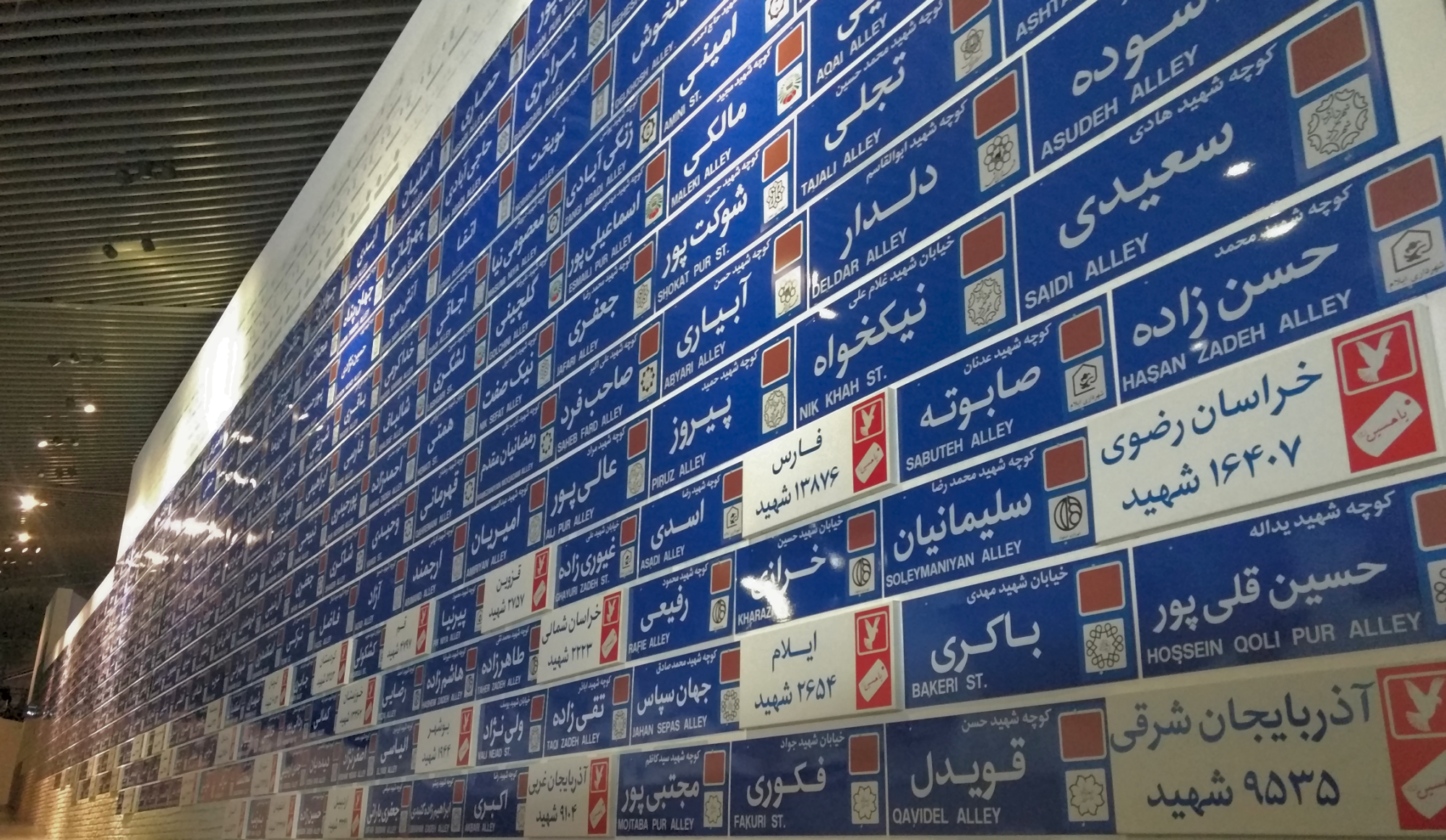
When you visit Iran today, you see the scars of the ‘imposed’ war[16] everywhere you look: from the streets and highways named in honour of the dead; to the almost nostalgic tributes regularly aired on state television; to the large, fading murals that adorn the sides of buildings and dominate city squares. Even my grandmother’s grave in Behesht-e Zahra, the largest cemetery in Iran, is situated next to one of the many large canopies built to house the war’s fallen soldiers.
This enduring culture of holy war and martyrdom may seem ‘imposed’ to many younger Iranians, but with Trump now vowing the ‘complete destruction’ of Iran,[17] I think there is every chance this ideology could be revived for a new generation, and I fear that the end result may be the same or worse. For now, Iran finds itself trapped somewhere between mythology and martyrdom.
بنیادِ ظلم در جهان اوّل اندکی بودهاست هر که آمد بر او مَزیدی کرده
“The foundation of tyranny in the world was small at first, but whoever came added to it” — Saadi Shirazi
Notes
1. Akhtar Makoii, “‘Apocalypse’ in Tehran after heaviest day of US-Israeli strikes.” The Telegraph. 3 March 2026. https://www.telegraph.co.uk/world-news/2026/03/03/apocalypse-tehran-heaviest-day-strikes-war/ .
2. Sarvy Geranpayeh, “Tehran’s Unesco-listed Golestan Palace reportedly damaged by US-Israeli strikes.” The Art Newspaper. 3 March 2026. https://www.theartnewspaper.com/2026/03/03/us-israeli-strikes-damage-unesco-listed-golestan-palace-tehran .
3. Sam Farzaneh, “Trump under fire for threat to Iranian cultural sites.” BBC. 6 January 2020. https://www.bbc.com/news/world-middle-east-51014237
4. Rebecca Schneid, “More than 1,000 Civilians Killed in U.S.-Israeli Bombing of Iran, Rights Group Says.” TIME. 4 March 2026. https://time.com/7382536/iran-civilians-killed-girls-school/.
5. Phil Stewart and Idrees Ali, “Exclusive: US investigation points to likely US responsibility in Iran school strike, sources say.” Reuters. 6 March 2026. https://www.reuters.com/world/middle-east/us-investigation-points-likely-us-responsibility-iran-school-strike-sources-say-2026-03-06z
6. Ghoncheh Habibiazad, “Fears over food shortages in Tehran as residents worry about length of war.” BBC. 3 March 2026. https://www.bbc.com/news/articles/cdr2ep48r33o
7. Owen Jones, “Western media in Iran propaganda overdrive.” Owen Jones Battlelines. 2 March 2026. https://www.owenjones.news/p/western-media-in-iran-propaganda
8. Scott Anderson, King of Kings (Random House, 2025), 196, 214-215.
9. Abbas Milani, The Shah (Palgrave Macmillan, 2011), 389.
10. "Referenda - Iran Data Portal." Syracuse University. Retrieved 6 March 2026. https://irandataportal.syr.edu/referenda#:~:text=After%20the%201979%20revolution%2C%20three%20referenda%20were,This%20section%20contains%20data%20on%20these%20referenda
11. Con Coughlin, Khomeini’s Ghost (Macmillan, 2009) 233.
12. Ali Dogan, “West Germany’s Secret Back Channel to Iraq.” Wilson Center. 6 July 2021. https://www.wilsoncenter.org/blog-post/west-germanys-secret-back-channel-iraq
13. Richard Connor, Timothy Jones, and Kate Hairsine, “Germany’s Merz says Israel doing ‘dirty work for us’ in Iran.” DW. 17 June 2025. https://www.dw.com/en/germanys-merz-says-israel-doing-dirty-work-for-us-in-iran/live-72939104
14. James Rothwell, “Merz: Iran should not be protected by international law.” The Telegraph. 2 March 2026. https://www.telegraph.co.uk/world-news/2026/03/02/friedrich-merz-iran-not-be-protected-international-law/
15. Pierre Razoux, The Iran-Iraq War (Harvard University Press, 2015), 471.
16. Ian Black, “Iran and Iraq remember war that cost more than a million lives.” The Guardian. 23 September 2010. https://www.theguardian.com/world/2010/sep/23/iran-iraq-war-anniversary.
17. Arsalan Shahla, Kateryna Kadabashy, and Bloomberg, “Trump says U.S. may target new parts of Iran in escalating war.” Fortune. 7 March 2026. https://fortune.com/2026/03/07/trump-us-targets-new-parts-iran-war-israel-drones/